
8. Reread. This may seem like a waste of time, but if you’re feeling spectacularly stuck, reread previous pages and consider adding detail. This is not “padding,” which I find such an ugly term anyway. I prefer to think of it as “fleshing things out.” Don’t always resort to this and don’t always spend hours and hours looking backward, as the whole point of NNWM is to plunge bravely ahead no matter what. But if you really feel like your plot needs help, adding things in earlier can give you more places to go later.
Category Archives: writing advice
Ten Tips for Getting Through NaNoWriMo without Losing Your Mind (Part VIII)
Filed under writing advice
Ten Tips for Getting Through NaNoWriMo without Losing Your Mind (Part VII)
Two tips today, as a little bonus since I haven’t updated this list in a while!
6. Write a poem in a very formal style from the perspective of each of your main characters at the moment you’ve left off with them. Something short, like a haiku or a sonnet. Sometimes working in a different genre can get you out of the rut of prose and force your perspective to shift, even if only temporarily.
7. Engage in ritual behavior. I’ve seen this suggested in countless other places as a cure for writer’s block in general, but this could be especially helpful when you’re engaged in an already overly routinized writing exercise, which is ultimately all NNWM really is. If you’ve already set aside a specific time of day for writing, as I suggested in earlier entries, then divide that writing time even further by setting little alarms and doing a specific action at the end of that smaller period of time. Write for 20 minutes, do 5 pushups. Write for 20 minutes, eat an M&M. Write for 20 minutes, walk up and down your stairs twice. Whatever it is, this little micro-break will serve a couple of purposes. First, it makes your writing time seem even less intimidating. You think an hour sounds tough? Well, 30 minutes is way easier, and 15 is even easier still. The physical action or activity will also allow you a second to breathe, to stretch, to clear yourself out of your intensity space and come back with just a tiny bit fresher perspective. Also, you may find that some days your ideas are flowing so well that you hear the alarm sound and you opt not to take that micro break, that you’re too invested in what’s going on with your plot, and you just plunge ahead. It’s kind of like getting awakened ten minutes before your morning alarm goes off. Some days, you’ll decide to just go ahead and start your day ahead of the game, and some days you’ll decide you’re glad you woke up because you’ll appreciate that extra bit of sleep. Either way, you’ve been jostled a little and can make that decision on your own based on your specific needs. Personally, my back and neck usually need a second every so often to move and shift, and I’ll grab a yoga pose or a drink of water or just do some mindful breathing. Whatever I do, I return a minute or so later feeling just a little refreshed.
Filed under writing advice
Ten Tips for Getting Through NaNoWriMo without Losing Your Mind (Part VI)
5. Try a support team. The NaNoWriMo forums have lots of threads during November for “word sprint” challenges where you’re tasked with dashing off a certain number of words in certain number of minutes and then reporting back on how you did. These can be incredibly motivating. Another motivator could be meetups or bootcamps, where you meet either in person or virtually and hold each other accountable for your word count, or at least report on your word count at the end of your day or week. Writing support groups are incredibly important for a variety of reasons, but they can be especially motivating during NNWM season. Even if you’re not discussing the content of your work too much with your accountability crew, at least you’re commiserating on the basics. Did you get done what you said you would? If not, you have a few friends who will duly embarrass you enough that next time you’ll want to get the job done. If you know you have the psychological homework of having to tell people whether you met your goal or not, you might be that much more likely to do so.
Filed under writing advice
Ten Tips for Getting Through NaNoWriMo without Losing Your Mind (Part V)
4. When things go wrong, there’s always the weekend. Weekends—especially Saturday mornings—can be great times to spend playing catch-up. Let’s say it’s Saturday of a week where you couldn’t fit in time to write on either Tuesday or Friday. You’re now 3,334 words short, plus you still need Saturday’s 1,667 words for a grand total of 5,001 words needed to be churned out. Intimidating, right? Here’s where a lot of people give up entirely. Instead of throwing in the towel, look at this massive catch-up time as an opportunity to really delve deep into one of your characters’ psyches. Throw in a flashback sequence that explains something intrinsic about their present-day motivations. And remember that, yes, it may take you an hour to do each thousand-word chunk, but if you planned this adequately, you can grind this out during a time block that may only be otherwise used to sleep in. By the time you start craving lunch, you should be already done and feel very accomplished that you got back on that horse.
Filed under writing advice
Ten Tips for Getting Through NaNoWriMo without Losing Your Mind (Part IV)
3. Remember that this is 50,000 words, minimum. That means that for 30 days, you must write at a pace of approximately 1,667 words per day to stay on task. If you’re feeling slow and/or know that you can catch up on weekends, you could round this down to fifteen hundred or even round up to two thousand, whatever you feel comfortable with. Since you’re going for speed over quality during your first pass with this novel, you could even look at your typing speed for a rough guide as to how long this might take you. This blog post will hit about 300 words and took me about fifteen minutes to write, for example, so if I were trying to hit the magic 1,667 I’d estimate just under an hour for my daily goal. Of course, in practice, novel writing will take you more thought and more effort, especially if you didn’t already brainstorm enough ahead of time. But if you can keep to a pace that has you at the computer for about an hour a day, you could ostensibly get this accomplished without too much pain. Where do you find this magical extra hour a day? Lunch breaks, getting up a little earlier, going to bed a little later, cutting out that rerun of Cheers you watch when you get home. Whatever you do, it can be all in one sitting or in little bursts, but experience has told me that one sitting usually works better for keeping your narrative consistent. Get up an hour early every day and just get it done first thing, if need be. It’s only for a month, after all, and maybe you can use that as your regular daily writing hour from here on out.
Filed under Uncategorized, writing advice
Ten Tips for Getting Through NaNoWriMo without Losing Your Mind (Part III)
2. Keep things simple. This is not the time to need to do a lot of research, so go back to basics. Write what you know, or at least something you’ve thought of writing before. Set your book in present day, in a local city, town, or a place you’re familiar with (or one you’ve made up that’s based on a place you’re familiar with) so that you’re not racking your brain or encyclopedias for help. One thing that slows people down tremendously in NNWM work is quick little research breaks: “Oh, let me just look up this one small detail.” Three hours later, you’re behind in your daily word count, and that one little detail may be completely superfluous to the larger story. Put a special character that’s easy to find and replace later (e.g. ### or $%& or something else that’s unlike to show up otherwise), write yourself a note or highlight the text to show that you need to look something up during your editing phase at the end of the month, and move on.
Filed under writing advice
Ten Tips for Getting Through NaNoWriMo without Losing Your Mind (Part II)
1. Technically by the rules of NNWM, you’re not allowed to begin putting pen to paper or fingers to keys until midnight local time on November 1. That does not mean you can’t begin to brainstorm and keep ideas in your head, so by all means, begin to do so. Think first of a genre or a character before even devising a plot, and at least begin to think of a hook for that character. It’s much easier to have one main protagonist whose psyche you can really mine for material than a huge, sweeping ensemble cast when it comes to your NNWM book, primarily due to the short word count and abbreviated time you have to work. Make this character fully vivid in your mind so that by the time you sit down to write your first few sentences, you can simply mine that character’s personality for material, even if you have yet to design the plot.
Filed under writing advice
Ten Tips for Getting Through NaNoWriMo without Losing Your Mind (Part I)
As autumn approaches, lots of writerly types start thinking about whether or not they want to participate in National Novel Writing Month (for more information on what NaNoWriMo is, check out <http://www.nanowrimo.org/>). Many of us decide to try but then flounder and fail. Many of us succeed but feel our efforts are a bit shabby. And many of us don’t sign up at all because of fear, perceived lack of time, or writers’ block.
Over the next few days and weeks, I’ll share some of my successful concepts for making NaNo painless and fun and get you in the habit of writing on a regular basis.
If you’re even remotely considering participating in NaNoWriMo for the first time or the tenth time, you’ve got over three months to adjust your writing processes so that you feel comfortable and confident that you can write an entire book in just thirty days. It’s an achievable goal, even with holidays and work and all the busyness of daily life, trust me. You can do it.
Filed under writing advice
Learn from your editor
If you have other people look over your writing and you ask for editing/copyediting/proofreading work to be done to it, pay attention to the kinds of advice and help they provide and attempt to not simply make those changes but to understand the reasons for those changes as well. For example, if you see a lot of comma additions or deletions, don’t merely update your manuscript but take the time to say, “I am noticing a pattern here. What is the actual syntactical rule I’m not following?” Your editor will thank you the next time you present them with something to look over, as they will save themselves quite a bit of red ink if you have fewer errors with each piece you show them.
Filed under writing advice
Three Phases of Writing
Writing is 85% prewriting, 1% writing, and 14% rewriting.
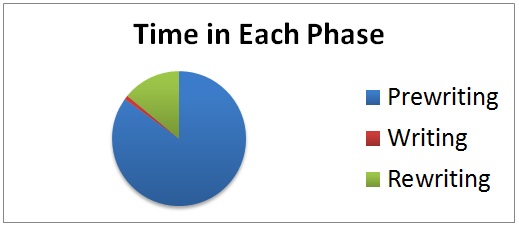
That’s not a lot of writing time, is it? Bear that in mind. The heavy lifting comes at the beginning and the end. I might argue that different styles/genres/types of writing might have the prewriting and rewriting percentages adjusted slightly, but the actual sitting down and churning out paragraphs of prose? That’s actually pretty negligible, which is why some folks are shocked they can actually manage to reach their goal in NaNoWriMo or similar challenges. You just have to get over the prewriting hurdle and then on the other end be willing to actually revise what you’ve written.
I was just listening to an interview on Marc Maron’s podcast where he talked to musician, writer, and performer Carrie Brownstein about how tough it was to write a book. They both joked that your house is never cleaner than when you’re supposed to be writing. And kidding aside, while some activities designed to procrastinate getting over writers’ block can actually be considered part of the prewriting phase, ultimately it really is procrastination. I think if most people realized that sometimes just showing up with fingers on the keyboard and going can be the best way to get over a hurdle.
After all, you’ll be rewriting anyway, right? Let go of that fear and just write.
Filed under writing advice

 K.W. Taylor